Lesson 2.1: NPS, DN, OD and Schedules — The Size Name Is Not the Bore
PipingDesigners Beginner Training Series · Pathway A, Module 4 · Lesson 2.1
Learning objectives
By the end of this lesson you should be able to:
- explain that NPS and DN are size names, not exact measurements of the bore or the wall;
- state why the outside diameter is fixed for a given size, while the inside diameter changes with schedule (or wall);
- distinguish schedule numbers from the older STD, XS and XXS designations, and know that they do not always coincide;
- apply the rule for NPS 12 and smaller versus NPS 14 and larger outside diameters, and confirm a size in a current standard or a checked tool;
- recognise that ISO/EN and ASME size series can use different outside diameters at the same DN, and that the project specification names the series that applies;
- explain what the “S” in a stainless schedule means, and why Schedule 40 and Schedule 40S must not be treated as interchangeable without a check;
- use the published NPS / DN / OD Cross Reference and Pipe by Schedule tools as a sanity check, not as a substitute for the governing standard or the project specification.
Technical explanation
1. Why this lesson sits here
In Lesson 1.1 you used size and schedule as examples of the data a specification holds. In Lesson 1.3 you saw that DN and NPS are different size languages, and that EN and ASME pipe can fail to butt cleanly at some common sizes. This lesson turns those ideas into working knowledge. Lesson 1.3 already pointed here as the next step; in the Beginner pathway it sits in Module 4, with the public number 2.1.
You will not memorise dimension tables. You will learn the rules that stop you modelling the wrong outside diameter, picking the wrong wall, or mixing two size series at a joint. When a number matters on a live job, look it up in the current edition of the standard the specification names. The tools on this site are a first check, not a substitute.
2. NPS and DN are names, not measurements
NPS means Nominal Pipe Size: the inch-based size name used with ASME pipe, fittings and flanges. DN means nominal size (from the French diamètre nominal). ISO 6708:1995 defines DN as the designation used for components of a pipework system in those standards that use the DN system. It does not define NPS, and it does not set the outside diameter.
Neither name is a call-out of the exact bore, and neither is a licence to convert the number as if it were a measured diameter. NPS 2 is not 2 inches outside, and it is not 50.8 mm. DN 50 is not 50 mm outside, and it is not 50 mm inside. Both labels point to a row in a dimensional standard. The outside diameter, the wall and the resulting bore come from that row — plus whatever the project specification says about the wall.
On many sizes an NPS designation and a DN designation share the same outside diameter (NPS 2 with DN 50 is the usual first example). That is a match of catalogue outside diameter, not a statement that two pipes are interchangeable.
3. The outside diameter is fixed for a given size
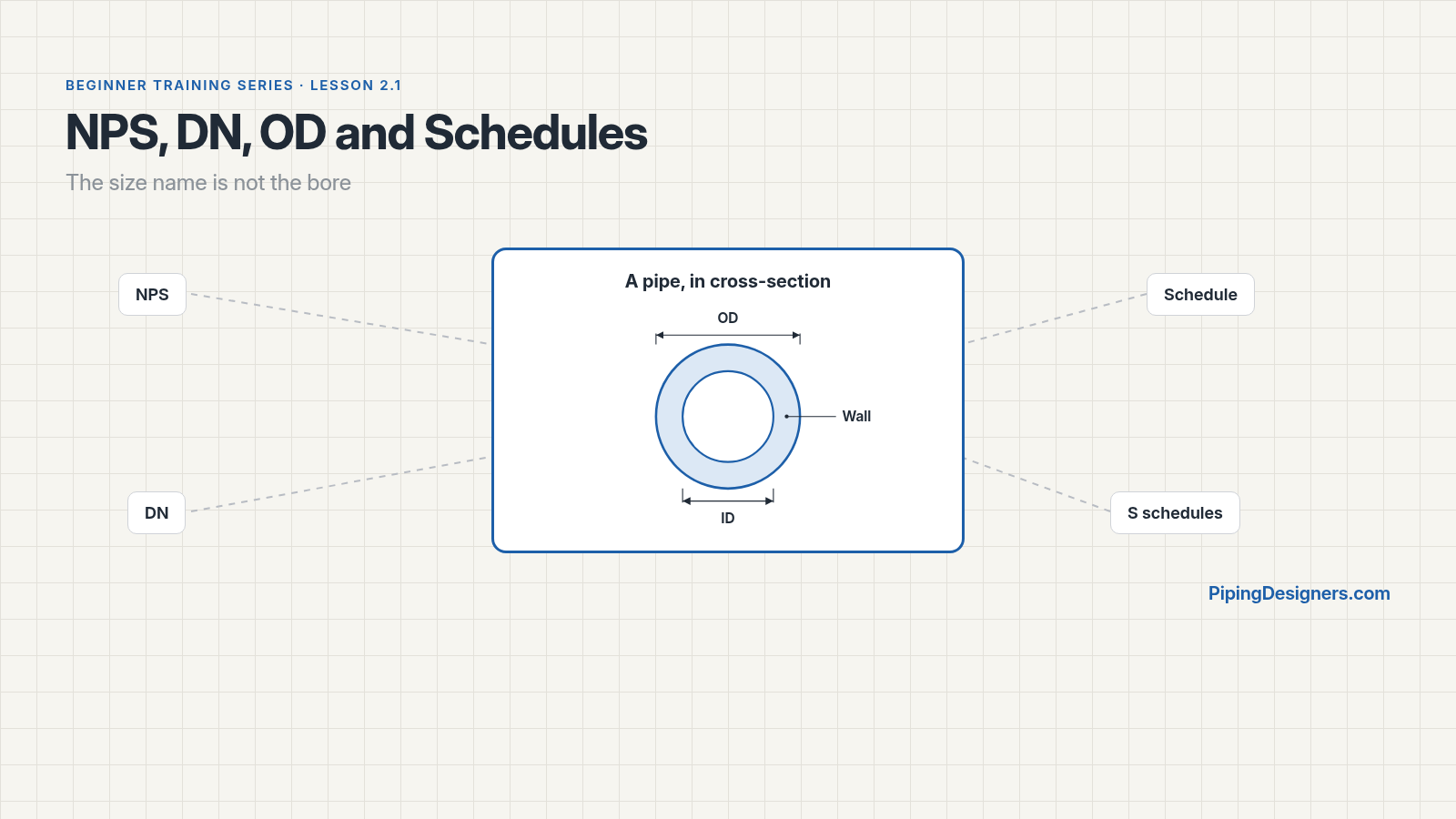
For a given NPS — or a given DN in a given series — the outside diameter is fixed. What changes when the schedule or the specified wall changes is the wall thickness, and therefore the inside diameter. Fittings, flanges and supports are made to a size, not to a schedule, because they have to fit that same outside diameter. A thicker wall eats into the bore:
inside diameter = outside diameter − (2 × wall thickness)
That figure is a nominal bore. It does not take off mill tolerance, corrosion allowance or lining. Those belong in later checks, and in Lesson A4.2.
If you remember only one picture from this lesson, remember this: two pipes with the same size name have the same outside diameter; the heavier schedule has the smaller hole down the middle.
4. Schedule numbers, STD, XS and XXS
A schedule is a wall-thickness designation for a given NPS. You will meet numbered schedules such as 5, 10, 20, 30, 40, 60, 80, 100, 120, 140 and 160, and the older names STD (Standard), XS (Extra Strong) and XXS (Double Extra Strong). The number is a name, not a percentage of the outside diameter and not a wall in millimetres on its own. The wall lives in the dimensional standard, for that size and that designation.
STD and Schedule 40 are not automatically the same thing, and XS is not automatically Schedule 80. They coincide over a limited size range and then they diverge. Look up the size in the current edition of ASME B36.10 — B36.10-2026 is now current; confirm the edition in force on the project — and in Pipe by Schedule. If the spec says STD, do not silently model Schedule 40 at a size where the two no longer match. The same caution applies to XS and XXS.
Some rows in the standard are listed as a plain wall with no schedule number. That is still a valid wall if the specification calls it up. Do not invent a schedule name for it.
5. The NPS 14 rule, and the sizes below it
A public ASME product description of B36.10 states that pipe NPS 12 (DN 300) and smaller has an outside diameter numerically larger than the corresponding size. NPS 2 is a 2-inch name with a larger outside diameter; you already saw that in Lesson 1.1. The same description contrasts this with tube, whose outside diameter is numerically identical to the size number for all sizes.
The usual corollary — confirm it in the current edition of ASME B36.10 and in the NPS / DN / OD Cross Reference — is that from NPS 14 upward, the outside diameter equals the nominal size in inches. NPS 14 is a 14-inch outside diameter; NPS 16 is 16 inches, and so on. NPS 12 is the last size at which the outside diameter is larger than the inch name; it is not a 12-inch outside diameter. Look it up, rather than guessing the sizes in between.
6. Metric series: ISO, EN and ASME are not always the same OD
DN tells you the size name in the EN and ISO world. It does not, by itself, tell you the outside diameter. The OD comes from the dimension standard the specification names.
The documents you will see cited most often for steel-tube outside diameters on European work are ISO 4200:1991, Plain end steel tubes, welded and seamless — General tables of dimensions and masses per unit length, and EN 10220:2002, Seamless and welded steel tubes — Dimensions and masses per unit length, often adopted nationally as BS EN, DIN EN or NF EN. EN 10220 classifies preferred outside diameters into Series 1, Series 2 and Series 3 according to how completely the matching accessories are standardised. Its public abstract recommends Series 1 for tubes used as components of piping systems. Series 2 and 3 may be harder to buy and harder to match. For stainless-tube dimensions, EN 10220 points to EN ISO 1127 — confirm the current edition if the specification calls it up.
ASME pipe takes its outside diameters from ASME B36.10 or B36.19. As Lesson 1.3 already warned, many sizes share an outside diameter between the two worlds, and several common sizes do not. Where they differ, an EN pipe and an ASME pipe — or the flanges and fittings that go with them — will not butt cleanly, even if both are tagged with the “same” DN. Use the NPS / DN / OD Cross Reference to compare what the site’s ASME and DIN catalogues store for the same DN, then confirm against the standard and series named in the specification. An equivalent on that tool is an outside-diameter match within a small display window, not a statement that the two pipes are interchangeable.
7. Stainless “S” schedules
Stainless pipe made to ASME B36.19 is designated with an “S” after the schedule number: 5S, 10S, 40S, 80S. The suffix “S” distinguishes B36.19 pipe from B36.10 pipe. Some “S” walls are not the same as the corresponding B36.10 walls. In the 2022 edition of ASME B36.19, the Schedule 40S difference is identified at NPS 12; Schedule 10S differs at NPS 14 through 22; and Schedule 80S differs at NPS 10 and 12. Do not generalise those exceptions beyond the sizes the standard identifies. ASME B36.19-2026 is now current; confirm the differences against the edition in force on the project. B36.10 also includes other thicknesses commercially available in stainless steel, so a stainless line is not automatically an “S” schedule. The specification decides.
Treat Schedule 40 and Schedule 40S as different catalogue rows. If the line class says 40S, model 40S. Required wall under pressure, corrosion allowance and mill tolerance are for Lesson A4.2 and for the responsible engineer.
Worked example
This example is a look-up, not a table of dimensions. Use the published tools to read the outside diameter and the wall, then calculate the inside diameter yourself. Confirm every figure against the edition of the dimensional standard in force on the project. ASME B36.10-2026 and ASME B36.19-2026 are now current. The site tools are a first check, not a substitute. The governing standard and the project specification take precedence.
The method is the same at every size:
inside diameter = outside diameter − (2 × wall thickness)
That inside diameter is a nominal bore. It does not take off mill tolerance, corrosion allowance or lining.
Example A — NPS 2 / DN 50, two carbon-steel walls
Open the NPS / DN / OD Cross Reference and look up NPS 2. Record the stored outside diameter and the equivalent DN, if one is shown. The name is “2”; the outside diameter is not 2 inches. Confirm the outside diameter in the edition of ASME B36.10 in force.
Now open Pipe by Schedule and compare Schedule 40 with Schedule 80 at that same size. For each designation, record the outside diameter and the wall the tool returns, then calculate the inside diameter from the formula above. What to notice:
- The outside diameter should be the same for both walls. A heavier schedule still has to fit the same size of fitting.
- The heavier wall reduces the bore.
- Check whether, at this size, the tool lists STD against Schedule 40 and XS against Schedule 80. If it does, that coincidence is size-specific, not a general identity. Confirm in the edition of ASME B36.10 in force.
Then compare Schedule 40 with Schedule 40S at the same size. Record whether the walls the tool returns match. A matching wall at one size does not make 40 and 40S the same designation. Confirm any S-schedule wall in the edition of ASME B36.19 in force.
Example B — where the schedule name stops being a safe shortcut
Change the size in Pipe by Schedule to NPS 12. Compare STD with Schedule 40. Record the walls the tool returns. If they differ, a line class that says STD must not be modelled as Schedule 40. Confirm both walls in the edition of ASME B36.10 in force.
Then compare Schedule 40 with Schedule 40S at NPS 12. In the 2022 edition of ASME B36.19, the Schedule 40S difference from B36.10 is identified at NPS 12; Schedule 10S differs at NPS 14 through 22; and Schedule 80S differs at NPS 10 and 12. Do not generalise the 40S exception to every size above NPS 12. Confirm the walls against the edition in force (B36.19-2026 is now current).
Finally, look up NPS 14 in the NPS / DN / OD Cross Reference. Confirm whether the stored outside diameter equals the 14-inch nominal size, as the NPS 14 rule predicts. Then look up NPS 12 and confirm that it does not. Confirm both look-ups in the edition of ASME B36.10 in force.
Exercise
Work this on the live tools. Record only the sizes you actually looked up, with the source and the date. Do not copy a standards table into your notes.
- In the NPS / DN / OD Cross Reference, look up NPS 2, NPS 12 and NPS 14. For each, record the stored outside diameter and the equivalent DN, if one is shown. Which of the three has an outside diameter equal to its inch name?
- Switch the lookup to DN 65. Compare the outside diameter stored in the ASME catalogue with the one stored in the DIN catalogue. Do they match? If they do not, write one sentence on what that would mean for a flange or a butt-weld fitting ordered to the other series. (This lesson does not print those diameters.)
- In Pipe by Schedule, select NPS 2 (DN 50) and compare Schedule 40 with Schedule 80. For each, record the outside diameter and the wall, then calculate the inside diameter (OD − 2 × wall). Then change to NPS 12 and compare STD with Schedule 40, and Schedule 40 with Schedule 40S. Record the walls the tool returns, confirm them in the edition in force, and say which designation you would model if the line class said “STD”.
- Open the Pipe by Schedule — Companion Article and find the provenance note on a B36.10 row and on a B36.19 row. In your own words, say what “interim data” and “verify against the current edition” mean for a number you have just written on a sketch.
If a figure on the tool disagrees with the project specification or the current standard, the specification and the standard win. Raise a query rather than “correcting” the spec from a website.
Knowledge check
- NPS and DN are best described as:
a) Exact measurements of the inside diameter
b) Size names that point to a row in a dimensional standard
c) Wall thicknesses in millimetres - For a given NPS, when the schedule gets heavier:
a) The outside diameter increases and the bore stays the same
b) The outside diameter stays the same and the inside diameter gets smaller
c) Both the outside diameter and the bore increase - Pipe NPS 12 (DN 300) and smaller, in the ASME B36.10 / B36.19 size system:
a) Has an outside diameter numerically larger than the size name
b) Always has an outside diameter equal to the size name in inches
c) Has no defined outside diameter - From NPS 14 upward, the usual ASME rule — to be confirmed in the current edition — is that:
a) The outside diameter is always 14 mm regardless of size
b) The outside diameter equals the nominal size in inches
c) The inside diameter equals the nominal size in inches - STD and Schedule 40:
a) Are the same wall at every NPS
b) Coincide only over a limited size range, so you model what the line class actually names
c) Are stainless designations - The “S” in Schedule 40S means:
a) The pipe is Schedule 40 carbon steel with a polish
b) The row comes from ASME B36.19; some 40S / 10S / 80S walls differ from B36.10
c) The wall is 40% of the outside diameter - An EN Series 1 tube and an ASME B36.10 pipe are both tagged DN 65. You should:
a) Assume they have the same outside diameter and bolt them together
b) Check the outside diameter in the standard and series the specification names
c) Convert DN 65 by multiplying 65 by 25.4 - You need a wall and a bore for a line on a live job. The formal answer should come from:
a) A remembered figure from this lesson
b) The project specification and the current edition of the standard it names, using a site tool only as a check
c) The thickest schedule you can find, “to be safe”
Answers
Answers: 1 b, 2 b, 3 a, 4 b, 5 b, 6 b, 7 b, 8 b.
References
Standards are cited by name and edition only. Their dimension tables are not reproduced here. Confirm the edition in force on the project. ASME B36.10-2026 and ASME B36.19-2026 are now current, superseding the 2022 editions (themselves revisions of B36.10M-2018 and B36.19M-2018, when the “M” suffix was dropped from the designation).
- ASME B36.10-2026, Welded and Seamless Wrought Steel Pipe. A public ASME product description of the standard states that pipe NPS 12 (DN 300) and smaller has outside diameters numerically larger than the corresponding sizes. Confirm that rule, and any size you model, in the edition in force.
- ASME B36.19-2026, Welded and Seamless Wrought Stainless Steel Pipe. In the 2022 edition, Schedule 40S differs from B36.10 at NPS 12, Schedule 10S at NPS 14 through 22, and Schedule 80S at NPS 10 and 12. Confirm those exceptions in the edition in force.
- ISO 6708:1995, Pipework components — Definition and selection of DN (nominal size). Published edition 2; confirm it remains current for the project.
- ISO 4200:1991, Plain end steel tubes, welded and seamless — General tables of dimensions and masses per unit length. Official ISO page stated this edition remains current (last confirmed 2018).
- EN 10220:2002, Seamless and welded steel tubes — Dimensions and masses per unit length (national adoptions include BS EN, DIN EN and NF EN). Public abstract: preferred outside diameters are classified into Series 1, 2 and 3 by accessory availability; Series 1 is recommended for piping systems. The standard points to EN ISO 1127 for stainless-tube dimensions.
- Published PipingDesigners tools, all verified on 25 November 2026: NPS / DN / OD Cross Reference and companion; Pipe by Schedule and companion (the companion states that its tables are interim data, not licensed ASME text, and must be verified against the current edition); Pipe Properties; Unit Converter; Standards Index.
- Lesson 1.1, Lesson 1.2, and Lesson 1.3.
Next lesson
Lesson A4.2 — Wall thickness and bore. That lesson is the place to distinguish a scheduled wall from a calculated or specified minimum wall, and to know when wall selection is an engineering task that must not be invented in the model. It is approved for development and does not yet have a published page.
Tell us what you think. This is part of the beginner training series and we want your feedback. Was it the right level? Too long, too short, anything missing or wrong? Leave a comment below.