AI Slop in Piping: Would You Put Your Name to It?
By Anton Dooley, piping designer, SPED PPD Level IV
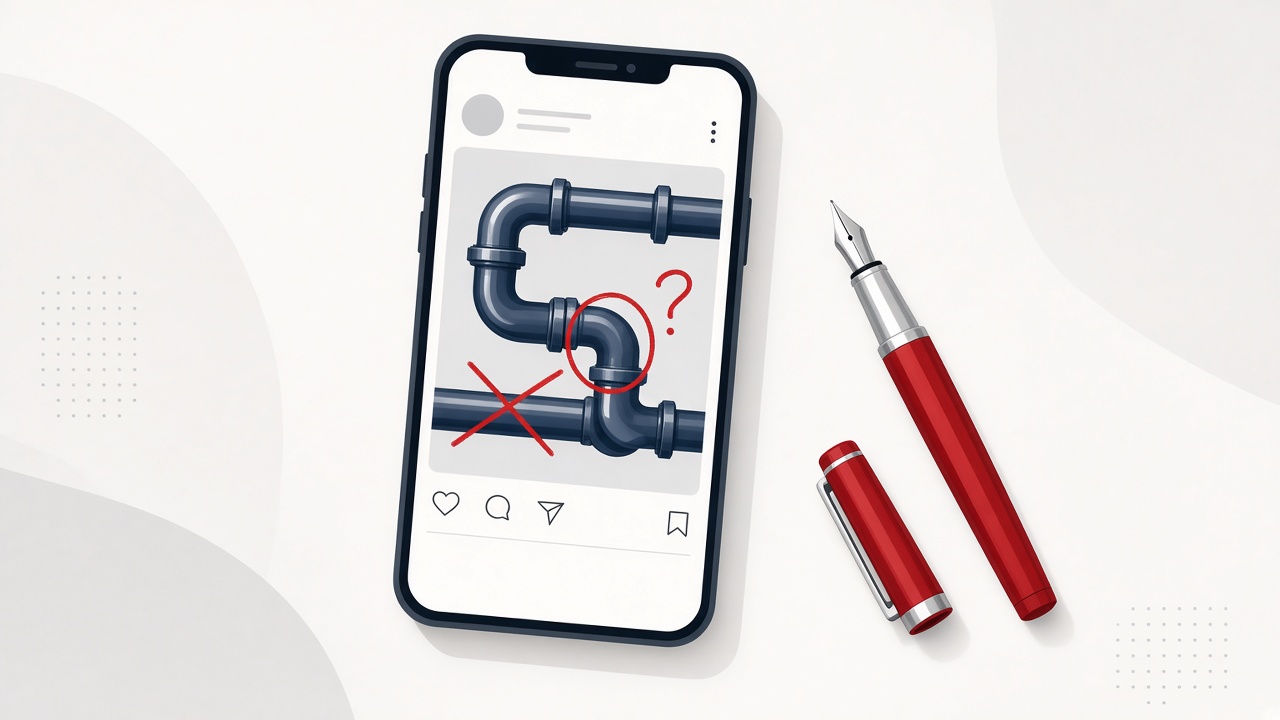
You know the post. A crisp graphic, a bold headline: “10 Pipe Support Rules Every Designer MUST Know.” Neat icons, a tidy colour scheme, a confident caption. It’s been shared, liked and praised in the comments.
Then you read it properly. Rule four is wrong. Rule seven depends entirely on the code, the service and the material, but doesn’t say so. The diagram labels a guide as an anchor. There’s no source, no context, and no sign that anyone with their name on a drawing ever checked it.
That example is an illustrative composite, written for this article. But you’ll recognise it. That’s AI slop. And if you work in piping, you’ve probably scrolled past more of it than you’d like.
I want to talk about it plainly, because it matters more in our trade than in most. But I also want to be clear from the start: this is not an anti-AI article. Far from it.
What we mean by “AI slop”
AI slop is content generated quickly, published without real checking, and dressed up to look like expertise. In piping and engineering feeds, it tends to show up in a few familiar forms:
- Generic lists that could have been written about any discipline, with “piping” swapped in.
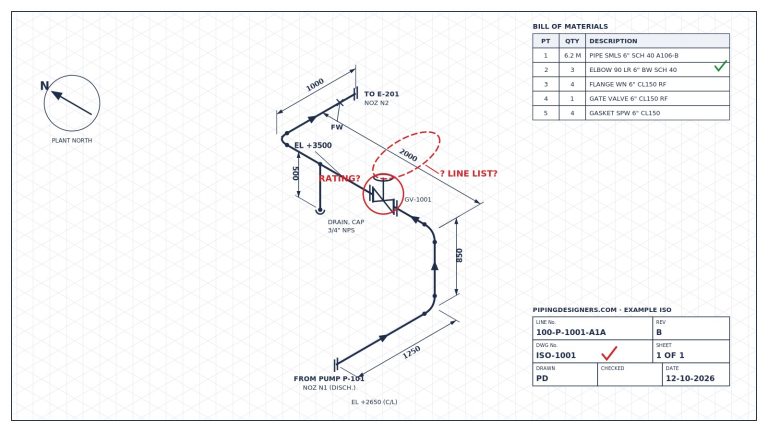
- Polished diagrams that are wrong. Flow arrows going the wrong way, fittings that don’t exist, dimensions that don’t add up, labels attached to the wrong component.
- Confident claims with no sources. A rule stated as universal with no code, edition, service or condition attached.
- False authority. The tone of a seasoned lead, with none of the qualifications, caveats or scars that real experience brings.
- Engagement bait dressed up as education. “Comment YES if you knew this”, or “Most engineers get this wrong”, followed by something that is either obvious or incorrect.
Why does it annoy people so much? Because it wastes attention, and attention is the one thing every busy designer is short of. Because it’s repetitive: the same ten points, reworded, again and again. And because it borrows the credibility of a profession that earned that credibility the hard way, through checking, sign-off and accountability.
This isn’t about AI versus no AI
Let me be straight. I use AI tools, and I think the profession should embrace them. They are genuinely useful for drafting, summarising, structuring a first pass, explaining a concept in a different way, or getting past a blank page. Used properly, they can save time and lift the quality of what we produce.
The problem isn’t the tool. It’s what happens, or doesn’t happen, between the tool and the publish button.
The dividing line isn’t AI versus no AI. It’s verified versus unverified, and accountable versus unaccountable.
A post written entirely by hand can be slop if nobody checked it. A post drafted with AI can be excellent if someone who knows the subject has interrogated every claim, added the context, and is prepared to stand behind it.
The test: would you rely on it? Would you put your name to it?
Every piping designer already knows this test. We apply it every time we sign a title block or initial a check print. The question is simple: would you rely on it, and would you put your name to it?
Applied to anything you read or publish, that test breaks down into five things:
- Evidence. Where does this come from? A code clause, a project standard, a vendor document, a test, real site experience? Or nowhere in particular?
- Context. What are the assumptions? Which code and edition? What service conditions, materials, pressure and temperature? Advice that is right for low-pressure utility water can be dangerously wrong for hot hydrocarbon service.
- Judgement. Does it explain why, not just what? Real experience shows up in the reasoning, the trade-offs and the “it depends, and here’s what it depends on”.
- Verification. Has anyone checked it against a source, a calculation or practice? Would it survive a decent checker?
- Accountability. Is someone willing to own it, correct it if it’s wrong, and answer questions about it?
If a post fails most of those, it doesn’t matter how good it looks.
Presentation is not verification. Fluency is not competence. Likes are not technical approval.
For junior designers and engineers: learning from your feed
If you’re early in your career, your feed can feel like a free masterclass. Some of it genuinely is. There are experienced people sharing hard-won lessons, and you should seek them out.
But you need a filter, because polished filler and real experience can look very similar at a glance.
Here are a few signs worth noticing:
- Real experience is specific. It names conditions, limits and exceptions. Slop speaks in absolutes.
- Real experience admits uncertainty. “On the projects I’ve worked on” or “check your project spec” is a good sign, not a weak one.
- Real experience explains reasoning. If a post tells you what to do but never why, be careful.
- Real experience usually has a person behind it who answers questions in the comments, corrects errors and engages with challenge.
Illustrative example (composite, written for this article): a graduate sees a confident post giving a “standard” support spacing table, with no reference to pipe size range, material, contents, insulation or the governing code. It looks authoritative, so they use it on a real job. The checker catches it, but only because the checker knew to ask where it came from.
That’s the risk. A confident post lifted into real work bypasses the very thing that keeps our work safe: knowing where the information came from and whether it applies. Treat your feed as a prompt for questions, not a source of answers. Take what you learn back to your codes, your project specifications and the senior people around you.
For senior designers and engineers: use AI, keep your voice
If you publish or mentor, you have something no tool can generate: your experience. The project that went wrong. The site query you’ll never forget. The detail you learned to check because it caught you out once.
That’s exactly what people want to read, and it’s what gets lost when AI writes the post for you.
Used well, AI can help you structure your thoughts, tighten your wording or turn rough notes into a readable draft. Used badly, it flattens everything into the same generic voice, strips out the hard-won specifics, and adds confident-sounding claims you never made.
A few habits help:
- Start with your own material. Notes, sketches, a real lesson. Let the tool shape it, not invent it.
- Check every claim it adds. If you wouldn’t say it in a design review, delete it.
- Keep the caveats. The conditions and exceptions are where your experience lives.
- Never post a diagram you haven’t checked as carefully as a drawing. Juniors will copy it.
Your name is on the post. Treat it like a check print.
For managers and leads: keep sign-off meaningful
This isn’t only a social media problem. The same pattern can creep into team knowledge bases, internal guidance, proposals and reports.
Illustrative example (composite, written for this article): a team wiki page on valve selection gets “tidied up” with an AI tool. It reads better, but somewhere in the rewrite a caveat about a specific service disappears. Months later, someone relies on that page. Nobody remembers who changed it or why.
AI output is fluent, and fluent text is easy to approve. A reviewer skims a well-written section, finds nothing jarring, and signs. But review that only checks whether something reads well isn’t review. It’s a rubber stamp.
If your team uses AI, and it probably should, then human review and sign-off have to stay meaningful:
- Be clear about who owns the content, whatever tool was used to draft it.
- Review against sources, not just readability. Ask where a claim came from.
- Keep the record. Who reviewed it, against what, and when.
- Make it safe to say “I don’t know where this came from”. That question should stop a document, not embarrass the person asking.
Humans adjudicate. Humans have the final word. Humans sign. That doesn’t change because the first draft came from a machine.
A challenge to the profession
Our profession runs on a simple idea: you don’t issue something you haven’t checked, and you put your name to what you issue. We apply that discipline to every isometric, every line list and every calculation. There’s no good reason to abandon it when we post, mentor or write a report.
So here’s my challenge:
- If you publish: only post what you would put your name to on a drawing.
- If you read: ask for the evidence, the context and the reasoning, politely but persistently.
- If you lead: make sure “reviewed” still means reviewed.
- And all of us: stop rewarding polish over substance. A like costs nothing, but it tells everyone else that a post is worth trusting.
Use AI. Embrace it. But keep a human in charge, keep the checking real, and keep your name meaning something.
Over to you
I’d like to hear real experiences, not hypotheticals. Have you seen AI-generated content in piping or engineering that was confidently wrong, or a case where AI was used well and the human checking made the difference? How does your team decide what gets verified, and who signs it off?
Share your experience in the comments. Please leave out names, clients and project details. The pattern is what matters.
If you wouldn’t sign it, don’t post it.