
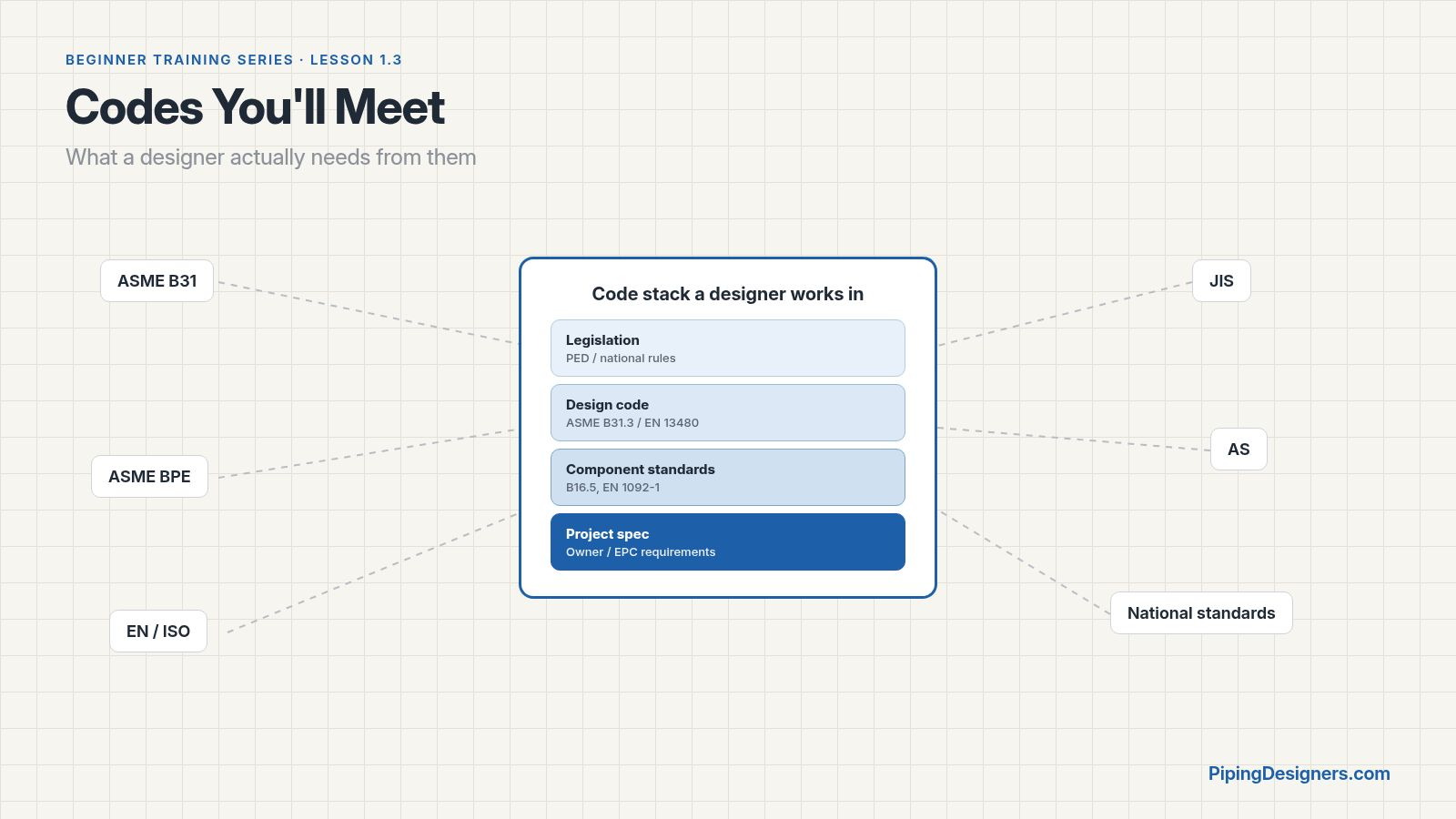
Lesson 1.3: Codes You’ll Meet — What a Designer Actually Needs from Them
PipingDesigners Beginner Training Series · Module 1 · Lesson 1.3
What you will learn
By the end of this lesson you should be able to:
- explain the difference between a code, a standard and a project specification;
- name the main ASME B31 piping codes a designer is likely to meet, and say in broad terms what B31.3 covers;
- outline what ASME BPE covers for hygienic biopharma piping, and how it is often used alongside B31.3;
- outline how the EU Pressure Equipment Directive and the UK Pressure Equipment (Safety) Regulations sit beside those codes;
- recognise the main EN / ISO piping, tube, flange and fitting families, including EN 13480 and EN 1092-1, and the difference between DN and NPS;
- name other national standard families you may meet on international projects, knowing that the project specification and country of installation decide which apply;
- use the PipingDesigners Standards Index to find the right document family without treating it as a substitute for the current edition.
1. Why codes matter to a designer
In Lesson 1.1 we listed codes and standards as one of the inputs around the 3D model. In Lesson 1.2 we saw how process data reaches the model. This lesson is about the rules underneath both: the minimum requirements for materials, design, fabrication, examination and testing.
You will not memorise code paragraphs as a beginner. You do need to know which document family applies, who on the project owns the detailed interpretation, and when to stop and ask. Guessing a wall thickness or a flange rating from memory is how unsafe work starts.
2. Code, standard, specification
People use these words loosely. For this series we keep them distinct:
| Term | What it means here | Example |
|---|---|---|
| Code | Mandatory or contractual minimum rules for a type of piping system | ASME B31.3; EN 13480 |
| Standard | An agreed document for components, materials, dimensions or methods | ASME B16.5; EN 1092-1; ASME BPE |
| Regulation | Law for placing equipment on a market | EU PED 2014/68/EU; UK PER 2016 |
| Project specification | The project’s own rules, which must meet the applicable code and regulations and may be stricter | The piping material classes in your spec |
Day to day you work from the project piping specification. That spec was written to comply with the governing code and with any regulations that apply where the plant is built or where equipment is placed on the market. If something is missing, raise a query with the piping materials engineer — the same habit as Lesson 1.1.
3. The ASME B31 family, in brief
ASME publishes the B31 Code for Pressure Piping in sections for different kinds of system. The ones you will hear most often are:
- B31.1 — Power Piping: steam, water and related piping in power plants and similar facilities.
- B31.3 — Process Piping: piping typically found in petroleum refineries, chemical and pharmaceutical plants, semiconductor and cryogenic facilities, and related process plants and terminals.
- B31.4 — Pipeline Transportation Systems for Liquids: liquid hydrocarbon and similar transmission pipelines between facilities.
- B31.8 — Gas Transmission and Distribution Piping Systems: gas transmission and distribution pipelines.
Other B31 sections exist. The design basis states which section governs which system. Crossing from a process unit onto a cross-country pipeline often means a code break at a defined flange or battery limit — agreed, not assumed.
4. What a designer actually needs from B31.3
For most process-plant designers, B31.3 is the section you meet first. In broad terms it covers materials and components, design, fabrication, assembly, erection, examination, inspection and testing of process piping, for fluids including chemicals, petroleum products, gas, steam, air, water, refrigerants and cryogenic fluids. Always check the current edition and the project’s stated edition; as of late 2024 ASME lists a 2024 edition of B31.3, and editions move on.
In practice you take habits, not memorised paragraphs:
- Use listed components and materials the project spec allows. Unlisted items need engineering review.
- Respect design pressure and temperature from the line list when you choose rating and wall.
- Know that fabrication and examination rules affect spool breaks and hold points on your isos.
- Leave unusual flexibility and support decisions to the stress engineer rather than “fixing” them in the model.
- Never copy a thickness or formula from an old note when the governing edition or fluid service may have changed.
B31.3 is not a layout manual. Pump suctions, valve access and operability come from good design practice, project standards and the reviews in Lesson 1.1.
5. ASME BPE — hygienic design for biopharma
On pharmaceutical and life-sciences work you will also meet ASME BPE (Bioprocessing Equipment). It covers the design of equipment and systems with high hygienic requirements — bioprocessing, pharmaceutical and related applications — including materials, design, fabrication, inspection, testing and certification.
For a piping designer that means hygienic tubing and fittings, surface finish, drainability and slope, dead-leg limits, and orbital welding for cleanable joints. The detail is in the current edition and the project hygienic specification; do not invent finish grades or dead-leg lengths from memory.
BPE does not replace B31.3. On many biopharma projects they sit together: B31.3 (including high-purity provisions where adopted) for pressure-piping safety and examination, BPE for hygienic / cleanability detail. ASME notes that BPE is referenced from B31.3. Follow the project’s stated combination, keep hygienic and utility systems separate in the model, and raise a query when a route would create a pocket, an uncleanable branch or a mixed-standard joint.
6. PED, UK PER and UKCA — the regulatory layer
In Europe and the United Kingdom, pressure equipment placed on the market is also covered by product-safety law:
- Directive 2014/68/EU — the Pressure Equipment Directive (PED), in EU member states.
- The Pressure Equipment (Safety) Regulations 2016 — UK PER 2016 / PE(S)R, for the Great Britain market.
Both apply, in broad terms, to pressure equipment and assemblies with a maximum allowable pressure (PS) greater than 0.5 bar, with listed exclusions. Piping is included when it is intended to be integrated into a pressure system. Category thresholds (fluid group, pressure, DN and related products) are for the project’s compliance lead and the manufacturer — not for a designer to invent.
Under the PED, harmonised European standards cited in the Official Journal offer a presumption of conformity with the essential safety requirements when correctly applied. EN 13480 and many tube, flange and fitting standards below sit in that family. Using a harmonised standard is a common route, not the only one.
In Great Britain, new in-scope equipment generally needs the appropriate conformity marking and English instructions; UKCA is the GB route in current GOV.UK guidance, and CE rules for Northern Ireland and EU markets can differ. Check the current official guidance for the market you are supplying.
On your desk: the piping specification and requisitions should already reflect the regulations; vendor packages bring their own conformity documents — do not quietly invalidate them at a tie-in; site-built piping under the user can sit under different in-service rules (in Great Britain, the Pressure Systems Safety Regulations are often named alongside PER). If asked to “just stamp it” without the responsible engineer, stop and escalate.
7. European EN and ISO standards
On European and many UK projects the component world is EN (European Norm), often published nationally as BS EN, DIN EN or NF EN. ISO standards sit underneath or alongside many of them.
EN 13480 — Metallic industrial piping is the European counterpart in role to ASME B31.3: a multi-part standard for design, materials, fabrication, installation, inspection and testing of metallic industrial piping on industrial sites. Check the current edition the project has adopted.
EN 1092-1 covers steel circular flanges designated by PN (for example PN 16 or PN 40) and sized by DN. That is a different language from ASME Class flanges (Class 150, 300, and so on). PN and Class are not interchangeable: bolt circles, facings and pressure–temperature curves differ. Never mate an EN PN flange to an ASME Class flange because the numbers “look close”.
Common tube and fitting families:
- EN 10216 — seamless steel tubes for pressure purposes (parts by material and temperature duty).
- EN 10217 — welded steel tubes for pressure purposes.
- EN 10220 (aligned with ISO 4200) — preferred outside diameters, walls and masses for steel tubes; the size series EN fittings expect.
- EN 10253 — butt-welding pipe fittings matched to that tube OD series.
DN versus NPS. DN is the metric size label used with EN/ISO piping; NPS is the inch-based ASME label. Both are names, not exact bore measurements. For many sizes the outside diameters match; at several common sizes they differ enough that EN and ASME pipe and fittings will not butt cleanly. Lesson 2.1 covers NPS, DN, OD and schedules properly (including the NPS / DN / OD Cross-Reference tool) — for now, know which size series your spec uses before you model.
On mixed or US-led jobs you will still meet ASME component standards:
- ASME B16 — flanges, fittings and valves (for example B16.5, B16.9, B16.11).
- ASME B36.10 / B36.19 — wrought pipe dimensions, including stainless.
- ASME BPE — hygienic tubing and fittings (section 5).
- API, MSS and others — as the spec calls them up.
Recognise the reference on the datasheet; look dimensions up in the project standard or the matching tool on this site.
8. Other national standards you may meet
International projects, brownfield tie-ins and vendor packages bring other national families. Which one applies is set by the project specification and the country of installation; always check the current edition. This table is a signpost only — not a dimension table, and not permission to mix standards at a joint.
| Family | Where you meet it | Examples a designer may see |
|---|---|---|
| JIS (Japan) | Japanese plants and many Asian-supplied packages | JIS B 2220 steel pipe flanges (K ratings such as 10K); JIS G pipe standards (for example G 3454 / G 3459) |
| AS / AS-NZS (Australia and New Zealand) | Australian and NZ pressure piping | AS 4041 pressure piping; AS 2129 flanges (tables such as D / E / F / H) |
| CSA (Canada) | Canadian boiler, vessel and pressure-piping registration | CSA B51 boiler, pressure vessel and pressure piping code |
| GB / GB/T (China) | Chinese plants and Chinese-supplied equipment | GB/T flange standards in PN and Class series (for example GB/T 9124); Chinese pipe standards on vendor data |
| GOST (Russia and CIS / EAEU) | Russian and Eurasian plants and packages | GOST 33259 flanges (older GOST 12820 / 12821 still on legacy drawings); separate GOST pipe and fitting series |
| DIN (Germany, legacy) | Older European plants and drawings | Older DIN flange and pipe numbers, many superseded by EN (for example EN 1092-1). Still written on brownfield documents |
| IS (India) | Indian plants and local supply | IS 6392 steel pipe flanges; specs may also call ASME or EN — follow the written spec |
| BS (United Kingdom, legacy) | Older UK plants; some Commonwealth references | BS 10 table flanges; BS 1560 Class-designated circular flanges. New work more often uses BS EN 1092-1 |
Two warnings. Flanges and fittings from different families can look similar and still have different bolt circles, facings or outside diameters. A package built to one family and a plant designed to another needs an agreed transition — a matched flange pair, an adapter spool or a defined code break — not a silent mismatch in the model.
9. Worked example: the Standards Index
Try it: open the Standards Index. Search for B31.3 and read the one-line scope. Then search for BPE, 13480 and 1092 if they appear, and for orifice with an ASME filter if offered. Try a national term such as JIS or EN and see what returns.
The index is a map, not the territory. Each card is a short PipingDesigners summary with a link toward the publisher. It does not replace the current edition, and it does not quote the standards. See the Standards Index — Companion Article, the Codes & Standards knowledge category and the Piping Standards Series.
Summary
- Codes set minimum system rules; standards describe components and methods; project specs apply both to the job.
- ASME B31.3 is the process-piping section most beginners meet; other B31 sections cover power and transmission systems.
- ASME BPE covers hygienic biopharma detail and is often used alongside B31.3, not instead of it.
- PED 2014/68/EU and UK PER 2016 add a legal conformity layer; harmonised EN standards are one common route.
- EN 13480 is the European industrial-piping counterpart to B31.3; EN 1092-1 uses PN and DN, not ASME Class and NPS.
- Other national families (JIS, AS, CSA, GB/T, GOST, DIN legacy, IS, BS legacy) appear on international work; the project specification and country of installation decide which apply.
- Use the Standards Index to find the document family, then check the current edition. When the spec is silent, raise a query.
Quick quiz
- ASME B31.3 is primarily the code for:
a) Cross-country gas transmission pipelines b) Process plant piping c) Building plumbing - A project piping specification should:
a) Replace the governing code b) Meet the governing code and may be stricter c) Only list paint colours - ASME BPE is most often met on:
a) Cross-country oil pipelines b) Hygienic biopharma and life-sciences piping c) District heating mains - PED 2014/68/EU and UK PER 2016 are examples of:
a) Component dimensional standards b) Product-safety regulations for pressure equipment c) Iso checking checklists - In broad terms, those regulations apply to pressure equipment with PS:
a) Equal to atmospheric pressure only b) Greater than 0.5 bar, subject to exclusions and category thresholds c) Only above 100 bar - EN 13480 is best described as:
a) A gasket colour chart b) The European metallic industrial-piping standard, a counterpart in role to B31.3 c) A US flange class table - EN 1092-1 flanges are designated by:
a) PN and DN b) Only ASME Class c) JIS K ratings alone - You need a flange dimension for a line in an ASME class. Where should you look first?
a) A random internet forum b) The project spec and the referenced B16 (or EN) standard c) An old sketch from another site - The Standards Index is best used to:
a) Replace buying or reading the current edition b) Find which document family covers a topic c) Generate legal conformity certificates
Answers: 1 b, 2 b, 3 b, 4 b, 5 b, 6 b, 7 a, 8 b, 9 b.
Next lesson
Lesson 2.1 — NPS, DN, OD and schedules. Module 1 ends here; Module 2 starts on the component data your specs hold.
Tell us what you think. This is part of the beginner training series and we want your feedback. Was it the right level? Too long, too short, anything missing or wrong? Leave a comment below.